Who can read your AI homework chat? Google Classroom's new boundary
Teacher-assigned AI tutoring can reveal where a learner gets stuck. Students also need to understand who can read the conversation—and what that record cannot prove.
 Pumpkin frame / 01
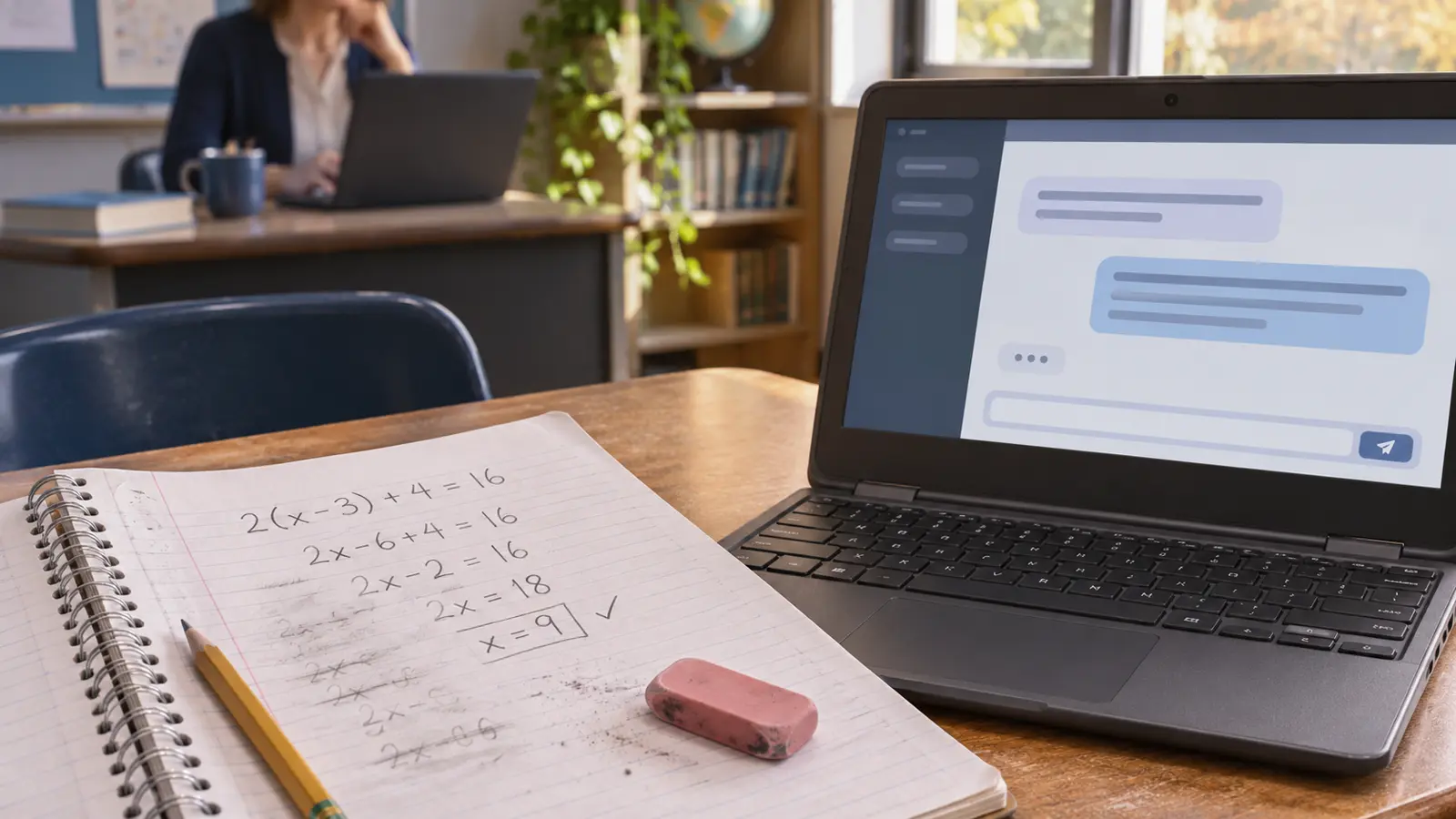
Original AI-generated editorial illustration, not a Google screenshot or a real classroom: an assigned learning conversation has an audience.
 Pumpkin frame / 02
Original AI-generated editorial illustration: a summary should prompt human review, not become a verdict on a learner.
The question behind the homework question
Imagine a learner asking an AI tutor the question they were too embarrassed to ask in class. The value is obvious: another chance to understand, without interrupting a lesson. Now imagine that learner discovering afterward that a teacher could read the exchange. The same feature can feel like support or an unexpected audience, depending on what was explained first. This is an illustrative scenario, not a report of a breach or a claim about a particular school.
The news is a new connection between a study conversation and classroom instruction. In its 4 November announcement, Google described Guided Learning activities attached to Classroom assignments, grounded in class materials and intended to offer questions and hints. It also described teacher access to insights and individual transcripts. The important story is not a robot replacing a teacher. It is the changing audience for a student's unfinished thinking.
What is rolling out—and what is not
Google's operational release notice says the extended rollout began on 3 November for Rapid and Scheduled Release domains, with feature visibility taking longer than 15 days. It lists Education Fundamentals, Standard and Plus. Both teachers and students need administrator-enabled Gemini access. A global rollout announcement therefore does not mean that every school account has the feature today.
A separate 3 November Google announcement also discusses a Guided Learning pilot in Search for selected US schools later in the month. That pilot is not the Classroom integration. The same announcement describes future changes to K-12 AI controls, with more detail to come; those plans should not be presented as controls already applied everywhere. Product names, dates and account types matter more than the breadth of an AI headline.
Assigned chat is not the same as personal chat
Google's student help page draws a specific line: teachers can review chats within activities they assigned, but not other personal Gemini chats through this feature. Students receive a notice about which conversations teachers can see. The documentation separately warns that school administrators may have account-review capabilities under school policy, including through Vault. Teacher visibility and administrative retention are different questions.
For a family, the useful starting point is not 'Can teachers see everything?' It is 'Which activity am I in, and who is its intended audience?' A conversation launched from a school assignment should be understood in that context. Conversely, it would be misleading to suggest that this launch gives every teacher a window into every student's unrelated AI conversation.
A summary is not a verdict on a child
The teacher documentation says transcripts require Gemini activity to be on. It describes class and individual insight summaries, but explicitly cautions that these can be mistaken and are not intended for assessment or placement. Teachers should check them against original work and transcripts. That qualifier is central, not a footnote.
Pumpkin AI's analysis is that a learning conversation records a moment, not a complete learner. A repeated question might mean confusion, curiosity, a language difficulty or an attempt to test an explanation. The transcript alone does not settle which interpretation is right. Turning a summary into a label risks flattening that uncertainty.
Consider a hypothetical student who asks for the same explanation three times and then solves the problem independently. A quick summary could draw attention to the repeated requests. A conversation with the teacher could reveal persistence. The responsible use of a new signal is to ask a better question, not to pretend the signal answers every question.
Deletion has more than one meaning
Google says a deleted assigned conversation no longer appears in the teacher's transcript view. Its teacher guidance qualifies deletion by administrator controls. Removing a Classroom post, meanwhile, removes access to the activity but does not delete earlier student conversations. These are different actions with different consequences.
That is why a school should avoid promising that a visible delete action erases every possible institutional record. Families deserve a plain explanation of the applicable account rules. This article describes the cited product documentation; it does not determine a school's legal obligations or certify compliance in any jurisdiction.
What a clear introduction to the feature should explain
Our recommendation is to explain the audience before asking for the conversation. A teacher introducing an activity could distinguish learning support from grading, explain that questions may be reviewed, and offer a way to raise a concern outside the AI chat. The wording should be understandable to the students actually using it, not only to procurement staff.
Schools can also separate the decision to offer an AI tool from the decision to rely on its interpretation. A useful pilot should look for evidence of understanding and appropriate human follow-up, rather than count chat messages as a substitute for learning. More interaction is not automatically more knowledge.
For parents, a practical conversation is about expectations: what the activity is for, what information does not belong in it, and whom to ask if an explanation seems wrong. For students, the important reassurance is that difficulty is part of learning. A record of questions should not make asking questions feel like a mistake. These are editorial recommendations, not claims that Google has required every school to follow this approach.
The trust test
AI tutoring offers a potentially useful second explanation at the moment someone needs one. Teacher visibility can help connect that moment to a lesson. Neither benefit removes the need for a clear boundary. Support is easier to trust when the learner understands the audience and the limits of the interpretation.
The question for school leaders is therefore concrete: could a student explain, in their own words, who can read this assigned chat and how it will be used? If the answer is no, the communication around the feature is not ready, even if the software is.
Questions worth asking.
Can a teacher see every personal Gemini chat?
No. Google's help page limits this feature to teacher-assigned Guided Learning activity chats. School-administrator access under institutional policies is a separate issue.
Is this available in every eligible account now?
Not necessarily. The extended rollout started on 3 November 2026 and takes longer than 15 days. Administrator-enabled Gemini access is required.
Should an AI insight decide a grade or placement?
Google says these insights are not intended for assessment or placement. Human review of the student's work remains essential.
Are these images actual classroom screenshots?
No. They are original AI-generated editorial illustrations. The generic interfaces and staged scenes are not documentary evidence or official Google product screenshots.
Sources and further reading.
- Guided Learning in Classroom rollout — 4 November 2026Google Workspace Updates
- Create and manage Guided Learning activities — checked 11 NovemberGoogle Classroom Help
- Complete a Guided Learning activity: what teachers can seeGoogle Classroom Help
- Designing responsible AI for learning — 3 November 2026Google
Related Pumpkin AI intelligence.


Need to act on the signal?